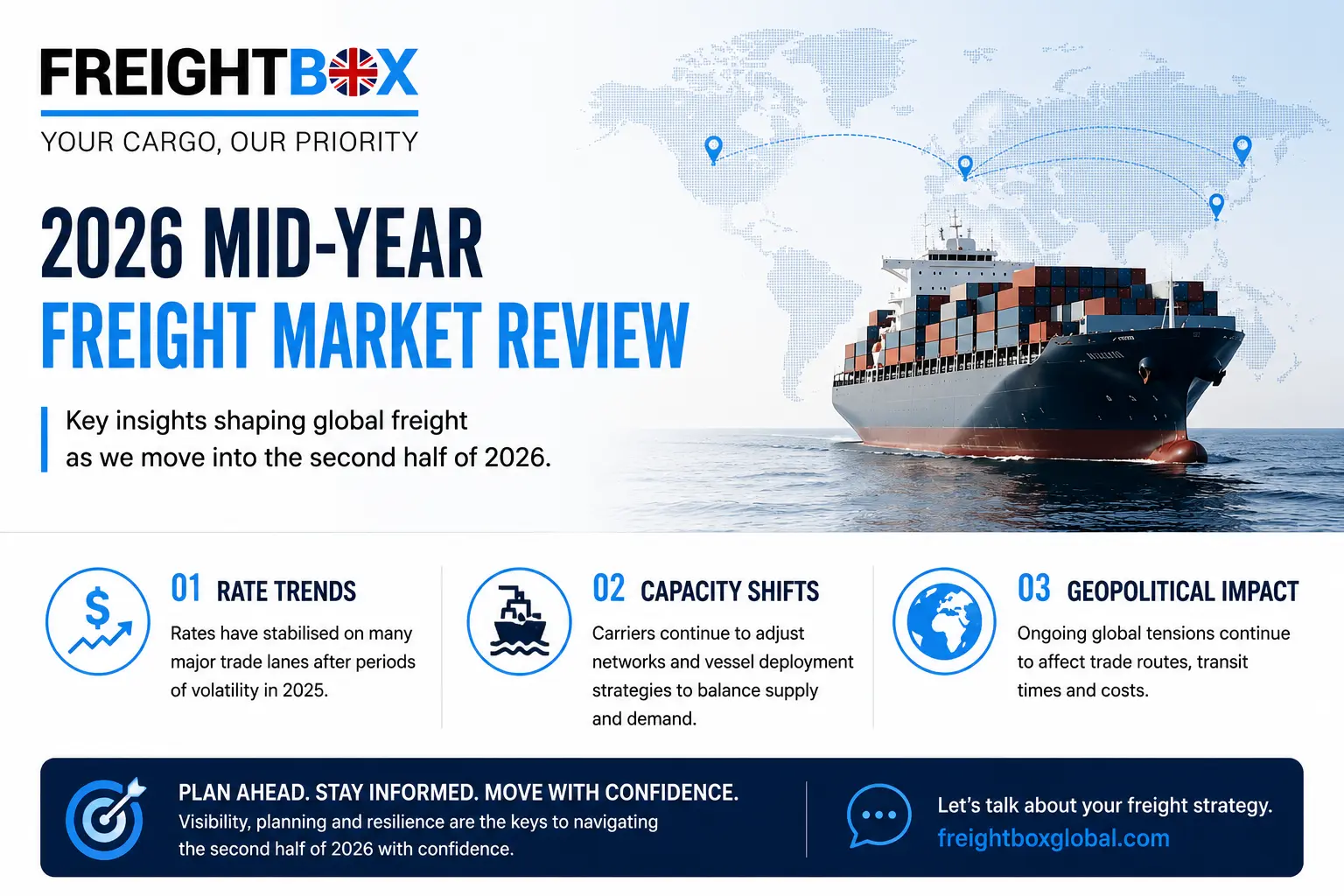
2026 Mid-Year Freight Market Review
As we move into the second half of 2026, the global freight market continues to evolve at a pace.
While many of the extreme disruptions seen in recent years have eased, importers and exporters are still navigating a landscape shaped by changing carrier strategies, shifting capacity, and ongoing geopolitical uncertainty.
We wanted to share a brief review of the key trends influencing freight markets so far this year and what they could mean for your supply chain.
Rate Trends
Freight rates across many major trade lanes have shown signs of stabilisation compared to the volatility experienced throughout 2025.
However, stability does not necessarily mean predictability.
Rates remain sensitive to:
• Carrier capacity management
• Equipment availability
• Changes in global demand
• Regional disruptions affecting key shipping routes
As a result, businesses should continue to monitor market conditions closely and avoid assuming current pricing levels will remain unchanged throughout the remainder of the year.

Capacity Shifts
Carriers have continued to adjust their networks and vessel deployment strategies in response to market demand.
Across Asia-Europe trade lanes in particular, we have seen:
• Ongoing service restructuring
• Blank sailings
• Capacity optimisation initiatives
• Changes to alliance networks and routing strategies
These adjustments are designed to balance supply and demand but can also impact transit times and available space.
Maintaining flexibility in planning and booking remains essential.

Geopolitical Impact
Geopolitical developments continue to play a significant role in shaping global supply chains.
Key areas affecting freight operations include:
• Continued disruption across Red Sea shipping routes
• Ongoing vessel diversions around the Cape of Good Hope
• Trade policy developments across major economies
• Regional economic and political uncertainty
These factors continue to influence transit times, operational reliability, and overall freight costs.
Looking Ahead
The businesses best positioned for the second half of 2026 will be those that focus on visibility, planning, and resilience.
Whether you’re importing from Asia, exporting into Europe, or managing global supply chains, having access to accurate market information and flexible logistics solutions has never been more important.
Are you planning differently in 2026?
Our team is here to help you move smarter, faster, and with complete confidence; contact us today on 0121 516 1903 or via our contact form.